
Project Roadmap & Capabilities
Bisync Hub is developed using disciplined, test-driven micro-iterations with strict zero-regression quality gates (>80% test coverage target).
  ┌──────────────────────────────────────────────────────────────┐
  │                   SHIPPED & AVAILABLE                        │
  │  • Interactive Review & Deletion Diff Modal                  │
  │  • 4-Analyzer Heuristic Conflict Confidence Engine           │
  │  • Cryptographic Immutable Audit Ledger (SQLite + SHA-256)   │
  │  • Go CLI Quality Engine (cmd/check) & E2E Testing Suite     │
  │  • Decoupled Service Architecture (Strictly <400 LOC)        │
  │  • Zero-Dependency Single Go Binary Distribution             │
  │  • Embedded Alpine.js / Tailwind CSS Management Cockpit      │
  │  • POSIX Advisory Locking & Local Path Confinement Jails     │
  │  • Real-Time Telemetry & Sync Status Reporting               │
  │  • Hybrid Fleet Overview & Multi-Profile Workspace (`beta.10`)│
  │  • 3-Tier Operational Flags & Provider Presets (`beta.10`)   │
  └──────────────────────────────┬───────────────────────────────┘
                                 │
                                 ▼
  ┌──────────────────────────────────────────────────────────────┐
  │             NEAR-TERM STRATEGIC PRIORITIES                   │
  │  1. In-Dashboard Configuration & Setup Manager (Rollback API)│
  │  2. In-App User Guidance & Interactive Diagnostic Manual     │
  │  3. Remote Mount Lifecycle Manager & Pooled Storage Engine   │
  │  4. Rclone RC Framework Hardening & Unix Socket IPC          │
  └──────────────────────────────────────────────────────────────┘
🟢 Shipped Capabilities (Available Now)
The following core modules are implemented, tested, and included in current binary releases:
1. Interactive Sync Review & Mutation Inspection
- Dry-Run Inspection Stream: Captures dry-run stdout/stderr, categorizing every action into
+ CREATE,~ MODIFY, or- DELETE. - Operator Review Modal: Halts destructive execution when deletion thresholds are tripped, allowing granular per-file approval or full-run abort.
- Rollback Resilience: Zero-byte hard link backups and recovery staging prevent accidental local wipes.
2. Multi-Analyzer Heuristic Conflict Engine
- 4 Parallel Heuristic Analyzers:
SizeDivergenceAnalyzer(30% weight): Detects unexpected file truncations and major additions.BinarySignatureAnalyzer(25% weight): Inspects MIME and magic bytes to reject corrupted partial writes.ClockSkewAnalyzer(25% weight): Compensates for provider-specific API clock rounding (e.g. OneDrive 2-second timestamp windows and DST shifts).VelocityAnalyzer(20% weight): Evaluates modification frequency to differentiate active work from background touches.
- Graduated Confidence Bands: Automatically commits resolutions scoring $\ge 85\%$, stages backups for $60\% - 84\%$, and safely quarantines $< 60\%$ collisions for manual operator review.
3. Cryptographic Immutable Audit Ledger
- Append-Only SQLite Storage: Schema-level
BEFORE UPDATEandBEFORE DELETEtriggers prevent modifying or purging existing ledger entries. - SHA-256 Cryptographic Hash Chaining: Links each block to its predecessor (
H_n = SHA256(H_{n-1} || payload || timestamp)), ensuring forensic tamper evidence. - In-Process POSIX Log Rotator: Thread-safe size-bounded rotation (
bisync.log) with lazy initialization and dual-stream audit logging ("type": "audit"). - Interactive Audit Explorer: Dedicated Web UI tab with live cryptographic chain verification, actor/action filtering, and CSV/JSONL compliance export.
- Recursive Secret Sanitization: Deep masking (
security.RedactSecrets) strips all tokens, secrets, and auth headers before persistence.
4. Production Go Architecture & Embedded UI
- Single Binary Artifact: Pure Go binary with embedded dashboard assets (
go:embed). No Node.js, Python, or external runtime required. - Advisory POSIX Locking: Race-free process exclusion via
syscall.Flockensures zero metadata collisions between background daemons and interactive CLI invocations. - Path Confinement Jails: Directory traversal (
../) prevention protects local storage roots. - Rclone Integration: Seamless inter-process communication with Rclone RC API and local filesystem synchronization.
5. High-Performance Go Quality Engine (cmd/check) & E2E Testing
- Parallel Quality Gate: Concurrent Go CLI check runner validating formatting, templates, line-count budgets, linters, and tests in under 10 seconds.
- Multi-Line HTML Attribute Tokenizer: True AST-style token parsing ignoring comments and detecting dotted boolean attributes (
:disabled,:readonly). - Headless Chrome E2E Suite: Smoke tests using
chromedpexecuting against the live embedded dashboard to verify real browser DOM reactivity. - Coverage Assurance: Statement coverage actively verified at 88.3% across all packages.
6. Decoupled Service Architecture (Sub-400 LOC Enforcement)
- Bounded Contexts: Core logic decoupled into focused domain engines (
TelemetryService,CanaryService,DeletionService,ReviewService,ExplorerService,SyncService). - Strict Maintainability Limits: All Go files strictly enforced to remain under ~400 lines of code to prevent architectural drift.
7. Multi-Profile Backend & 3-Tier Operational Flags Engine
- Independent Workload Scheduling: Spawns isolated runner goroutines per profile with dedicated advisory lock confinement (
/tmp/rclone-bisync-<id>.lock) and SQLite state tracking. - 3-Tier Operational Flags Architecture: Fine-grained flag inheritance model (
Execution Override > Profile Override > Global Default > Hardcoded Fallback). - POSIX Shell Argument Tokenizer & Security Blocklist: Safe tokenizer with hard blocklist preventing command injection and unauthorized override of daemon flags (
--config,--rc,--use-mmap,--log-file,--json).
🟡 Near-Term Strategic Priorities (In Development)
The following capabilities represent our immediate development milestones following public launch:
Priority 1: Hybrid Fleet Overview & Contextual Profile Workspace
- Objective: Deliver a workload-centric dashboard hierarchy supporting fleet-wide visibility and profile-scoped management.
- Architecture:
- Level 1 Fleet View: Central command dashboard with aggregate health summary counters (
Total,Healthy,Needs Review,Failing,Syncing), interactive tile grid, and instant quick-actions (Sync Now,Dry Run,Settings). - Level 2 Scoped Workspace: Context-aware workspace with global header profile switcher dropdown and breadcrumb navigation.
- Visual 3-Tier Flags Editor: Interactive parameter controls with live inheritance badges (
Inherited from GlobalvsProfile Override) and client-side security blocklist validation. - Refer to Hybrid Fleet Overview & Contextual Workspace Specification.
- Level 1 Fleet View: Central command dashboard with aggregate health summary counters (
Priority 2: In-Dashboard Configuration & Setup Manager
- Objective: Provide safe visual editing of sync flags, intervals, and remote setup.
- Architecture:
- Visual Flag Editor: Adjust
--buffer-size,--tpslimit, conflict strategies, and webhook endpoints safely from the UI. - Setup & Onboarding Wizard: Guided visual setup wizard for initial Rclone RC remote pairing and environment configuration.
- 3-Layer Safety Pipeline: Automated backup snapshots, SHA-256 integrity match, and schema validation before applying changes.
- One-Click Rollback API: Restore historical configurations immediately if a change fails verification.
- Visual Flag Editor: Adjust
Priority 3: In-App User Guidance & Diagnostic Manual
- Objective: Enhance operational clarity and assisted recovery directly within the UI.
- Architecture:
- Contextual Tooltips & Policy Explanations: Inline tooltips and modal banners explaining safety triggers (
TOO_MANY_DELETES,MANDATORY_SUBDIR, heuristic risk scores) in plain language. - In-Dashboard Reference Manual: A dedicated slide-over panel summarizing CLI commands, Rclone flags, and step-by-step conflict recovery workflows.
- Interactive Diagnostics: Integrated troubleshooting guides for resolving OAuth token drops, path permissions issues, and systemd service status.
- Contextual Tooltips & Policy Explanations: Inline tooltips and modal banners explaining safety triggers (
Priority 4: Remote Mount Lifecycle Manager & Storage Pooling (internal/mount)
- Objective: Turn fragile OS FUSE mounts into resilient, self-healing virtual storage endpoints.
- Architecture:
- Stage A (Remote Mount Manager): Pure-Go daemon managing
rclone mountsubprocess lifecycles on Linux (FUSE) and Windows (WinFsp) with keepalive probes and clean unmount handlers (fusermount -u). - Stage B (Pooled Storage Engine): Provision stacked multi-cloud topologies (
union+chunker+crypt) over RC/config/create. - Refer to Remote Mount Manager Design Specification.
- Stage A (Remote Mount Manager): Pure-Go daemon managing
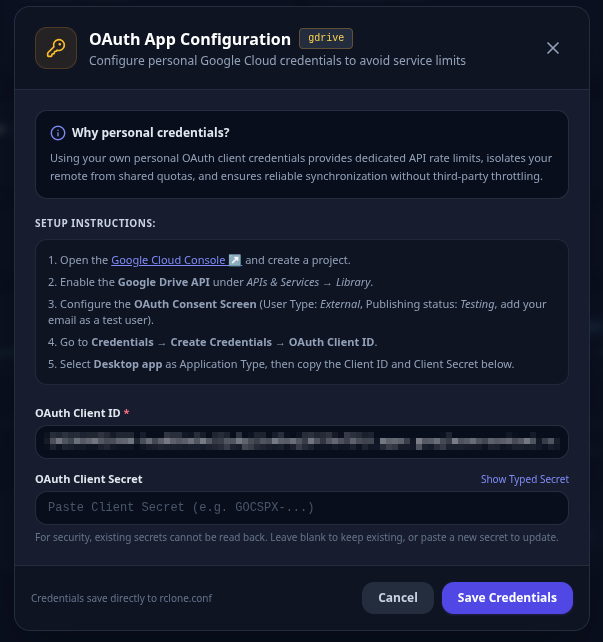
Google Drive OAuth Client ID, Secret & scope setup
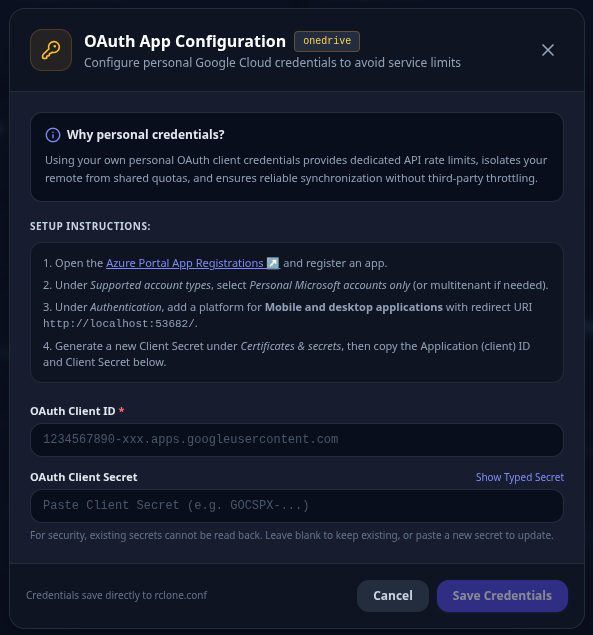
OneDrive OAuth Personal & Business Graph API setup
🔮 Future Vision & Research
- Peer-to-Peer State Coordination: Multi-node cluster coordination for organizations synchronizing across distributed branch offices.
- Encrypted Remote Telemetry: Zero-knowledge telemetry syncing enabling multi-device sync status monitoring without exposing file metadata.